

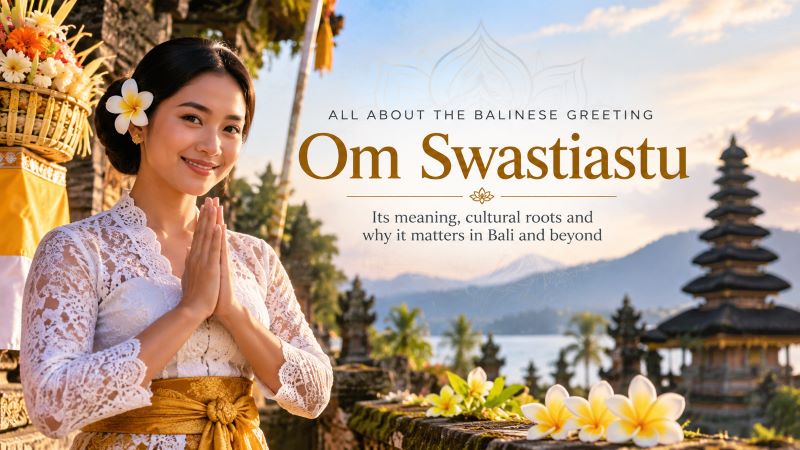
Om Swastiastu: When a Greeting Becomes a Blessing
In Bali, a simple greeting carries a beautiful wish for wellbeing. For Indoindians, it is also a reminder of the cultural connections that bring India and Indonesia closer.
If you have visited Bali, chances are you have heard the words Om Swastiastu. Spoken as a welcome, exchanged at gatherings or heard at the beginning of a ceremony, this familiar greeting carries a meaning that goes far beyond hello.
For those of us who live in Indonesia, it offers a glimpse into the rich cultural heritage that surrounds us. And for the Indoindians community, it opens a window into the fascinating connections between Indian heritage and Indonesian life.
Om Swastiastu is more than a greeting. It is a wish for wellbeing, auspiciousness and divine blessing.
What Does Om Swastiastu Mean?
Rooted in Sanskrit and deeply woven into Balinese Hindu tradition, the greeting expresses a heartfelt wish for wellbeing and auspiciousness under the grace of the Divine.
Its three elements carry their own significance. Om is a sacred syllable in Hindu traditions, associated with the Divine and ultimate reality. Swasti conveys wellbeing, auspiciousness and good fortune. Astu expresses the sense of “may it be so” or “let it come to pass.”
Together, they convey a beautiful sentiment: May there be wellbeing and auspiciousness.
It is a lovely way to begin an encounter — not merely by acknowledging another person, but by wishing them well.
An Ancient Prayer for the Wellbeing of All
The Sanskrit idea of swasti also appears in an evocative prayer in the Śrīmad-Bhāgavatam, an important Hindu sacred text.
In Canto 5, Chapter 18, Verse 9, Prahlāda Mahārāja offers a prayer beginning with svasty astu viśvasya — a wish for good fortune throughout the universe.
The prayer asks that hostile minds become peaceful, that living beings wish one another well and that the mind be devoted to the Supreme Lord without selfish motive.
Its message extends beyond personal happiness. It imagines a world where wellbeing is wished for everyone, even those with whom we may disagree.
Although this verse does not establish the direct historical origin of the Balinese greeting, it offers a meaningful scriptural parallel. Both bring us back to the Sanskrit idea of swasti and the aspiration for wellbeing.
Perhaps that is what makes the greeting so universal: its underlying sentiment is something we can all understand, whatever our background or beliefs.
India and Indonesia: A Shared Cultural Story
One of the most fascinating aspects of living in Indonesia is discovering how cultural influences travel, take root and develop their own identities.
For centuries, maritime trade and cultural contact connected the Indian subcontinent with the Indonesian archipelago. Sanskrit, literature and religious ideas travelled across the region, influencing local languages, artistic traditions and spiritual life.
In Bali, Hindu traditions evolved alongside local customs, ceremonies, arts and community practices. Balinese Hinduism has its own distinctive identity and history, shaped over generations.
Om Swastiastu reflects this layered heritage. Its Sanskrit roots connect it to a wider history of cultural exchange, while its everyday use belongs to the living traditions of Bali.
For Indians in Indonesia, it can feel like encountering a familiar cultural thread in a new setting. For Indonesians interested in India, it offers a glimpse into the historical connections that have helped shape the region.
And for anyone curious about culture, it is a reminder that the most meaningful connections are often found in the smallest details — a greeting, a gesture, a shared word or a familiar value expressed in a different way.
The Beauty of a Simple Gesture
The greeting is often accompanied by a respectful gesture, with palms joined in front of the chest and sometimes a slight inclination of the head, very similar to the Indian ‘Namaste’
For visitors to Bali, learning Om Swastiastu is a thoughtful way to engage with local culture. Listen to how it is used, offer it respectfully and appreciate the tradition behind it.
At Indoindians, we believe that understanding a place goes beyond visiting its landmarks or sampling its food. It comes from learning about the people, beliefs and traditions that shape everyday life.
A greeting may take only a moment to say, but understanding its meaning can change the way we experience the place where we live or travel.
The next time you hear Om Swastiastu in Bali, listen beyond the words. Think of the heritage they carry, the tradition that gives them meaning and the goodwill they express.
And when you offer the greeting yourself, let it be more than a polite hello.
Om Swastiastu — may there be wellbeing and auspiciousness for all.
For further reading: Śrīmad-Bhāgavatam 5.18.9 — Vedabase