
Ubud Writers & Readers Festival 2026 – When Stories Awaken the Heart and Inspire Action
21–25 October 2026 | Ubud, Bali
There is something magical about Ubud in October. The air carries the scent of tropical gardens, incense drifts through temple courtyards, and the gentle rhythm of Balinese life offers a welcome pause from the noise of the modern world. For five days, this cultural heartland of Bali will become a meeting place for writers, readers, artists, journalists and thinkers from across the world, gathering for one of Southeast Asia’s most anticipated literary celebrations: the Ubud Writers & Readers Festival (UWRF) 2026.
Returning from 21 to 25 October, the festival enters its 23rd year with a theme that feels especially relevant to our times: Samarasā: Awareness. Empathy. Action. More than a celebration of books and the people who write them, this year’s festival invites us to consider how stories can change the way we see the world, deepen our understanding of others and inspire us to act.
At a time when conversations are often reduced to headlines, online arguments and hurried opinions, UWRF offers something increasingly precious: the opportunity to slow down, listen carefully and engage with ideas that may challenge our assumptions. It reminds us that behind every statistic is a human story, behind every conflict are lives and communities, and behind every meaningful change lies the possibility of seeing things differently.
Samarasā: A Meeting of Mind, Heart and Action
Rooted in Sanskrit philosophy, Samarasā explores the harmony between Citta, or mind; Rasa, or heart; and Karsa, or action. Its message is both simple and powerful. Awareness helps us understand. Empathy allows us to connect. Action turns that understanding into purpose.
Festival Founder and Director Janet DeNeefe describes the theme as an invitation to explore the forces that shape our lives, from technology and spirituality to personal experience and the environment. The larger question is how we can respond to the world with greater compassion and a clearer sense of responsibility.
This idea gives the festival a distinctive character. Literature is not presented as an escape from reality, but as a way of entering it more deeply. A novel may help us understand migration and belonging. A journalist’s investigation may reveal uncomfortable truths about power. A memoir may give voice to experiences that have long remained hidden. A conversation about the environment may transform an abstract concern into something immediate and personal.
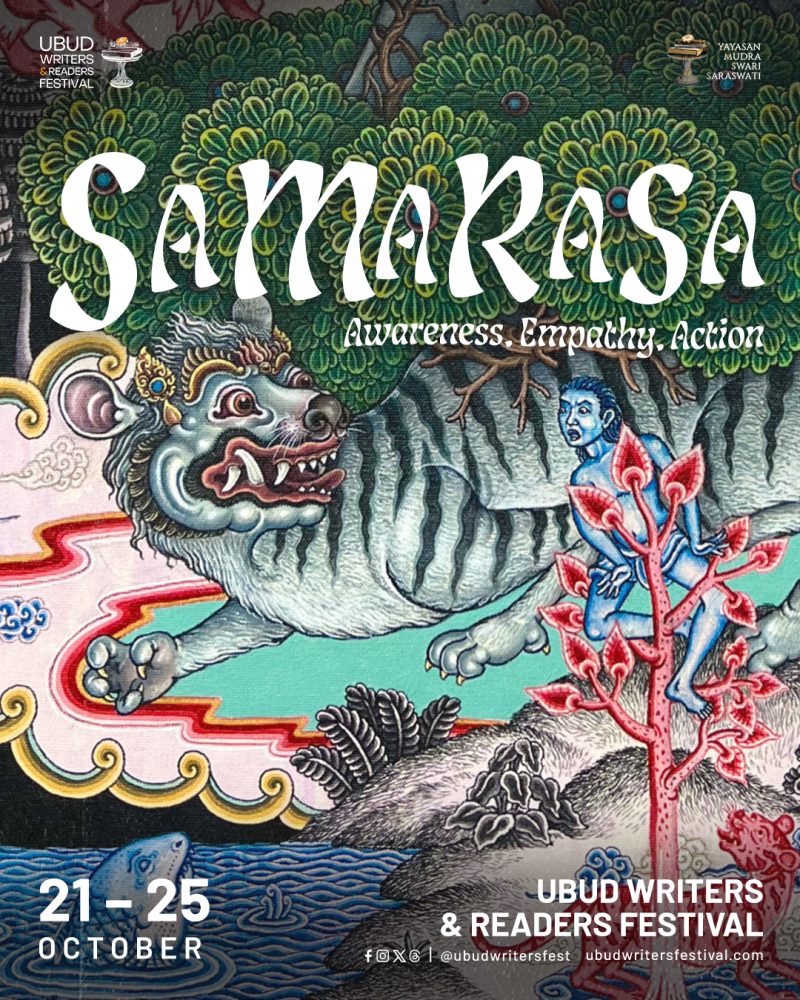
The festival’s official artwork, created by Balinese contemporary artist Wayan Aris Sarmanta, captures this spirit through a dreamlike world where humans, nature and mythical beings appear interconnected. Drawing on the visual traditions of Batuan painting while bringing his own contemporary sensibility, Sarmanta creates an image that encourages viewers to look beyond the obvious and discover unexpected connections.
It is a fitting visual introduction to a festival built around the belief that our stories, identities and futures are more closely linked than we sometimes realize.
Literary Stars and Stories That Cross Borders
The 2026 program brings together more than 150 writers, journalists, artists, poets and thinkers from Indonesia and around the world, with over 100 sessions across the festival. The line-up spans fiction, memoir, journalism, politics, culture, science and the environment, offering readers many ways to explore the questions shaping our lives today.
Among the most anticipated guests is Booker Prize-winning novelist Kiran Desai, who will discuss The Loneliness of Sonia and Sunny. Her sweeping novel explores migration, identity and the complicated experience of belonging across cultures. These are familiar themes for many members of the Indian diaspora, whose lives often unfold between countries, languages, family traditions and changing ideas of home.
Malaysian author Tash Aw brings The South, a novel shaped by family, place and the uncertainties of growing up. Booker Prize finalist Katie Kitamura presents Audition, which examines the roles people perform for others and the uncertain boundaries between public identity and private self.
Fashion designer and author Prabal Gurung brings another perspective on identity and ambition through his debut memoir, Walk Like a Girl. Known internationally for his designs, Gurung reflects on the realities of building an independent creative career. His appearance adds an interesting dimension to the festival, reminding us that storytelling extends beyond literature into fashion, art and the ways we present ourselves to the world.
The program also makes room for voices willing to confront difficult questions. Palestinian author Adania Shibli, known for Minor Detail, explores violence, historical memory and the stories that remain untold. Pakistani writer Fatima Bhutto presents The Hour of the Wolf, which examines abuse, survival, power and silence. Australian-Palestinian author Randa Abdel-Fattah brings Discipline, a work that raises questions about who gets to tell stories and whose voices are heard.
These conversations speak directly to the festival’s theme. Listening to perspectives different from our own is not always comfortable, but it can be an important first step towards understanding the world beyond our immediate experience.
Indonesia’s Stories Take Centre Stage
While international writers draw global attention, the festival’s strength lies equally in its commitment to Indonesian voices. Indonesia is a country of extraordinary cultural and linguistic diversity, and its literature offers a window into experiences that are often overlooked in international conversations.
Investigative journalist and filmmaker Dandhy Laksono returns to questions of power, accountability and public life through his documentary work, including Sexy Killers, Dirty Vote and Pesta Babi. His work demonstrates the role journalism and documentary storytelling can play in encouraging public debate.
Writer Dian Purnomo explores difficult social realities through her novel Perempuan yang Menangis kepada Bulan Hitam, which addresses the practice of forced bride kidnapping in Sumba. Other Indonesian writers bring different aspects of the country’s history and identity into focus. Raisa Kamila examines Acehnese resilience and historical memory, Valiant Budi writes about the experiences of migrant workers, and poet Cyntha Hariadi explores language and colonial heritage.
The program also connects Indonesia’s literary inheritance with contemporary creative expression. Louie Buana draws on the La Galigo manuscripts, the great Bugis epic preserved in poetic form, to explore how an ancient literary tradition can continue to speak to modern readers.
These stories remind us that Indonesia cannot be understood through a single narrative. Its experiences are shaped by geography, history, faith, social change and the lives of people whose perspectives deserve to be heard.
For readers in Indonesia, the festival offers an opportunity to discover writers who illuminate the country from within. For international visitors, it opens a door to a richer understanding of the archipelago beyond its beaches, temples and familiar tourist destinations.
Discovering the Next Generation of Indonesian Writers
One of UWRF’s most meaningful contributions is its Emerging Writers program, established in 2008 to identify, mentor and introduce new Indonesian literary voices to wider audiences.
For 2026, the program received 634 submissions from across the archipelago, from Aceh to Papua. After a two-stage selection process, ten writers were chosen: Ajen Angelina, Arianto Adipurwanto, Carisya Nuramadea, Dhias Nauvaly, Galuh Ginanti, Hamran Sunu, IRZI, Jein Oktaviany, Nityasa Wijaya and R. Abdul Azis.
Their stories reflect the complexities of contemporary Indonesian life, addressing subjects ranging from land dispossession and environmental concerns to gender, social relationships, history and digital culture.
The selected writers will participate in preparatory sessions and workshops before their work appears in the annual Stories From the Islands anthology, which will be launched during the festival. Published in Indonesian and English, the anthology offers an important opportunity for emerging writers to reach readers beyond their immediate communities.
UWRF is about more than discovering promising talent. It recognizes that a literary culture grows when new writers are given the time, guidance and encouragement to develop their voices. By connecting emerging authors with established writers and international audiences, UWRF helps create pathways for Indonesian stories to travel further.
It is also an invitation to readers to look beyond familiar names and discover the voices that may shape Indonesian literature in the years to come.
More Than Talks and Book Signings
For those who imagine a literary festival as a series of author talks in quiet halls, UWRF offers a much broader experience. The festival includes panel discussions, book launches, writing retreats, masterclasses, cultural workshops, literary lunches, spoken-word performances and evening events.
The festival’s special events bring literature into intimate and unexpected settings, from conversations over meals to performances that combine words, music and visual expression. These experiences create opportunities to encounter ideas in a more personal way, where a discussion can continue long after a formal session has ended.
For aspiring writers, the festival offers opportunities to learn from experienced practitioners. Award-winning author and journalist Peter Godwin leads a memoir-writing retreat from 18 to 20 October, exploring how personal memories can be shaped into compelling narrative non-fiction and autobiographical writing. Hong Kong author Xu Xi leads a separate retreat on 19 and 20 October, focusing on Asian narratives, identity, displacement and belonging.
Workshops and masterclasses extend the festival’s reach beyond established literary audiences, welcoming people interested in developing their writing, discovering creative techniques or simply learning to look at familiar subjects in new ways.
There is also a strong sense of community. Readers can meet authors whose books have stayed with them, discover unfamiliar genres and exchange recommendations with people who share their interests. Sometimes the most memorable festival moments are not found in a scheduled session, but in an unexpected conversation over coffee or a discussion that continues over dinner.
Ubud itself is part of the experience. Its independent cafés, galleries, restaurants, temples and leafy streets provide a natural setting for a gathering devoted to ideas and creativity. The town’s cultural life gives the festival a character that would be difficult to reproduce in a conventional conference center.
A Festival for Curious Minds
UWRF is also making space for the next generation of readers. The festival has announced free access to its main program for Indonesian students from elementary, junior high and senior high schools, helping young people experience the world of literature and creative expression.
This initiative recognizes that a love of reading can begin with a single encounter: a story that feels familiar, a writer who asks an unexpected question, or a discussion that opens up a new way of thinking. Giving students access to writers and ideas can help nurture curiosity long after the festival has ended.
For adults, too, the festival offers a reminder that reading is not simply about collecting information. It is about developing imagination, questioning assumptions and learning to understand lives different from our own.
In an increasingly digital world, where information is abundant but attention is fragmented, the act of listening to a writer speak about the experience behind a book can feel especially valuable. It brings the human being back into the story.
Why UWRF Matters
The significance of UWRF extends beyond its five days of events. It creates a space where Indonesian and international voices can meet on equal ground, where difficult subjects can be discussed, and where literature becomes a bridge between cultures.
For the Indian community in Indonesia, the festival holds particular appeal. Questions of migration, identity, belonging, cultural inheritance and the meaning of home are central to many diaspora experiences. The stories explored in Ubud may emerge from very different histories, yet their emotional questions often feel familiar: Where do we belong? How do we preserve our heritage while embracing change? What does it mean to understand someone whose life is unlike our own?
The festival does not promise easy answers. Instead, it creates the conditions for better questions and more thoughtful conversations.
That is perhaps the most compelling aspect of Samarasā. Awareness without empathy can remain detached. Empathy without action may achieve little. The challenge is to bring all three together, allowing what we learn and feel to influence how we live.
As Ubud prepares to welcome writers and readers from around the world, the invitation is open to everyone who believes that stories matter. You do not need to be a writer, an academic or a devoted literary enthusiast to take part. You only need curiosity and a willingness to listen.
Between 21 and 25 October, Ubud will once again become a place where words travel across borders, ideas meet in unexpected ways and stories invite us to see the world through someone else’s eyes.
And perhaps that is where meaningful change begins: not with a grand declaration, but with a story that makes us pause, a conversation that shifts our perspective, or a moment of understanding that stays with us long after we have left.
Ubud Writers & Readers Festival 2026
Dates: 21–25 October 2026
Location: Ubud, Bali
Theme: Samarasā: Awareness. Empathy. Action.
Explore the program and ticket options at ubudwritersfestival.com.