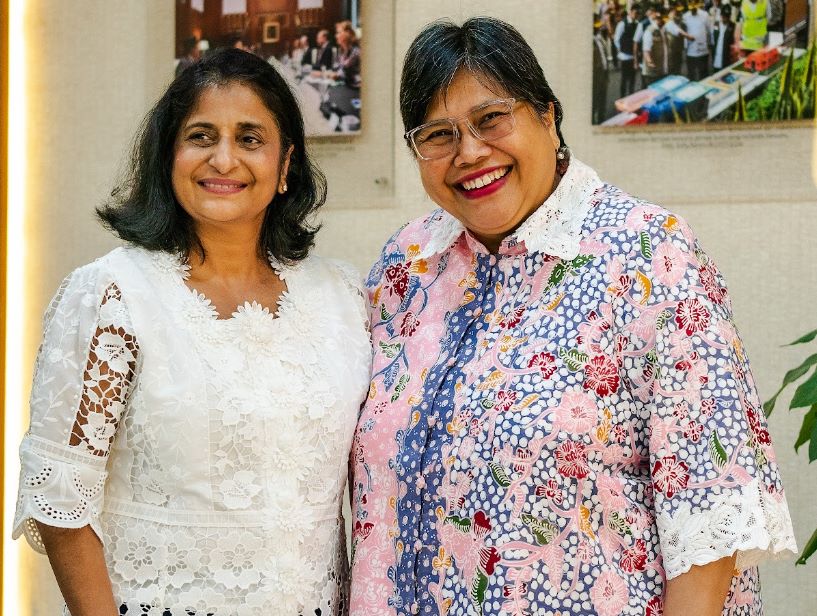

H.E. Ambassador Ina Hagniningtyas Krishnamurthi, former Ambassador of Indonesia to India, says the two countries share far more than their cultural connections suggest, but need greater two-way engagement in trade, education, tourism and among young people
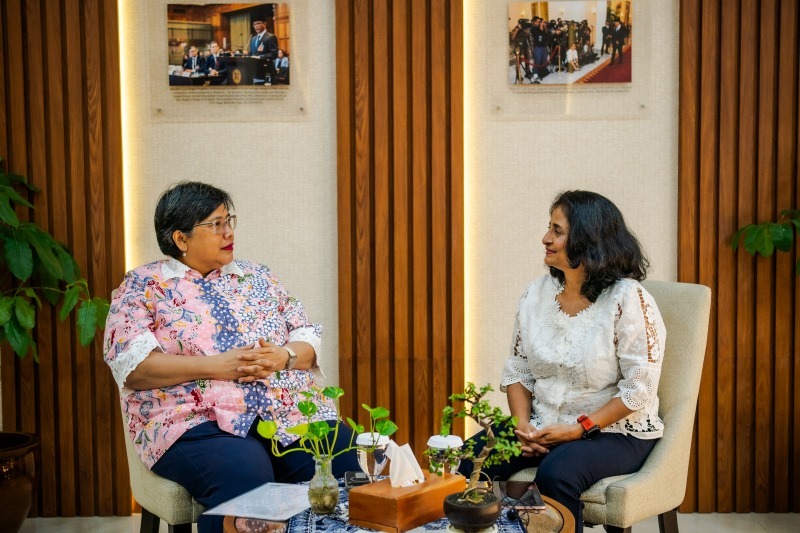
Speaking to Indoindians in an interview for its Leadership Series, Ibu Ina reflected on her four-and-a-half years in India and argued that the relationship between the two countries remains significantly below its potential. She has spent decades at the heart of Indonesian diplomacy — from the United Nations and complex international trade negotiations, to four years as Indonesia’s Ambassador to India. Today, she serves as Indonesia’s Director General of ASEAN Cooperation.
“There are more similarities than differences between Indonesia, Indonesians and India and Indians,” she said, describing her time in India as an experience that changed her understanding of both countries. However, one of the biggest challenges was that Indians and Indonesians continued to view each other through limited and sometimes outdated perceptions.
India, she said, often sees Indonesia primarily through Bali, Borobudur and its Hindu-Buddhist heritage, while Indonesians’ understanding of India has been strongly shaped by Bollywood films and music. The historical and cultural links are important, she said, but they cannot be the sole foundation of the relationship.
“It is not a love, one-sided love,” Ibu Ina said, arguing that understanding between the two countries must be reciprocal.
Beyond Bali and Bollywood
The former ambassador said she was particularly frustrated by the tendency to equate Indonesia almost exclusively with Bali.
During her posting, she sought to promote destinations such as Yogyakarta and Central Java, where the temples and historical heritage offer another important connection with Indian visitors.
Improved air connectivity became an important part of that effort.
Ibu Ina cited the establishment of direct connections including Delhi–Bali and Mumbai–Jakarta, along with other routes linking Indian cities with Indonesia, as among the achievements of her tenure.
A direct Yogyakarta connection, however, remained an unfinished goal.
For her, better connectivity was not simply a tourism initiative. It was a way of creating more opportunities for people from the two countries to meet, travel, conduct business and discover one another beyond familiar stereotypes.
She noted with satisfaction that Indian visitors and pilgrims were increasingly travelling to Yogyakarta, including to sites such as Prambanan.“At least finally, there’s some traction,” she said.
Economic ties need a new conversation
The same need for greater mutual understanding applies to trade and investment, according to Ibu Ina.
India and Indonesia are both major markets, but she believes their economic relationship has yet to reach its potential.
The former ambassador pointed to India’s advances in digital finance and manufacturing as examples of capabilities that are not sufficiently recognized in Indonesia.
The solution, she suggested, is to shift the conversation away from perceived weaknesses and towards areas where the two countries can combine their strengths for mutual benefit.
“The understanding between the two countries has to be much greater in terms of current economic situation,” she said. “And more towards what can we do together. Not only benefit for only one party, but for both.”
Ibu Ina also pointed to a local-currency transaction agreement as an initiative she hoped would progress, describing it as part of a broader effort to strengthen economic cooperation.
Education as an untapped opportunity
One area she wished she had been able to advance further during her ambassadorial tenure was education.
She specifically identified opportunities in vocational education linked to healthcare, including nursing, radiology and pharmaceuticals.
India’s education ecosystem was among the aspects of the country she admired most.
Her appreciation extended beyond formal education institutions to India’s culture of reading and access to books, magazines and journals.
“I think India is one of the most attentive countries in the world on education,” she said.
For Ibu Ina, education could become another practical bridge between the two countries, particularly where India’s experience and Indonesia’s needs intersect.
The diplomacy behind President Prabowo’s Republic Day visit
Ibu Ina also offered a rare glimpse behind the scenes of Indonesian President Prabowo Subianto‘s appearance as Chief Guest at India’s Republic Day celebrations in January 2025.
The invitation carried particular historical significance. Indonesia’s first President, Sukarno, had been the Chief Guest at India’s first Republic Day in 1950, while 2025 marked 75 years of diplomatic relations between India and Indonesia.
Ibu Ina said she had initially not expected Indonesia to be selected, given the competition among diplomatic missions in New Delhi to secure the prestigious invitation.
She had, however, consistently highlighted the importance of the 75th anniversary and Indonesia’s historic connection to India’s first Republic Day.
The eventual decision came as something of a surprise even to her.
“Suddenly, one ambassador approached me: ‘Ina, how come Indonesia was decided?’” she recalled.
The symbolism of Prabowo’s visit was particularly striking because it effectively linked the beginning of India’s Republic Day tradition with the 75th anniversary of bilateral relations.
Ibu Ina also credited India’s Ambassador to Indonesia, Sandeep Chakravorty, for playing an important role in helping push the visit forward.
A changing global order
From her vantage point across bilateral diplomacy, ASEAN and the United Nations, Ibu Ina believes India and Indonesia have significant common interests as the international system evolves.
Both countries have historic links to the Global South and were founding participants in the 1955 Asian-African Conference.
But she cautioned against viewing the future through the lens of the past.
“What we need to do from now on is not see the world as it was,” she said. “But we need to see the world in the future.”
For her, that future is closely connected to young people.
India and Indonesia have large youth populations, creating an opportunity for the two countries to build stronger relationships among the next generation.
“To talk about the future, we need to talk about the youth,” she said.
Her prescription was succinct: “Catch them young.”
The implication is significant for bilateral relations. Building connections between young Indians and Indonesians through education, travel, culture, business and professional networks could create a constituency for closer ties long after today’s diplomatic leadership has moved on.
Women and the changing face of diplomacy
Ibu Ina’s own career also illustrates the changing role of women in Indonesian diplomacy.
When she joined the diplomatic service in 1993, her cohort consisted of 47 junior diplomats, only seven of whom were women.
Today’s cohorts are dramatically more balanced, she said, with recent intakes approaching or exceeding gender parity.
But she argued that the discussion should go beyond representation.
Recalling conversations with former Indonesian Foreign Minister Retno Marsudi, Ibu Ina questioned whether women in diplomacy should be viewed primarily through the lens of gender.
“Diplomacy is not about the gender only,” she said. “It’s about the merit.”
At the same time, she believes women can bring valuable strengths to diplomacy, particularly in peace reconciliation, conflict prevention and confidence-building.
The greater participation of women, she suggested, can contribute to a better balance in international diplomacy.
The personal cost of public service
For all the discussion of international relations and diplomacy, one of the most revealing moments of the interview came when Ibu Ina was asked about the personal sacrifices of a long public career.
Her answer was immediate. “My privacy.”
She joked about seeing her face increasingly appear on websites, magazines and online searches, but acknowledged that visibility is one of the costs of a career in public service.
Yet when asked how she would like to be remembered once the title of ambassador is no longer the first thing associated with her, her answer was strikingly modest.
“I just want to be reminded as a good diplomat,” she said.
Then she added: “As a person, I just want to be remembered as a nice, smiley person.”
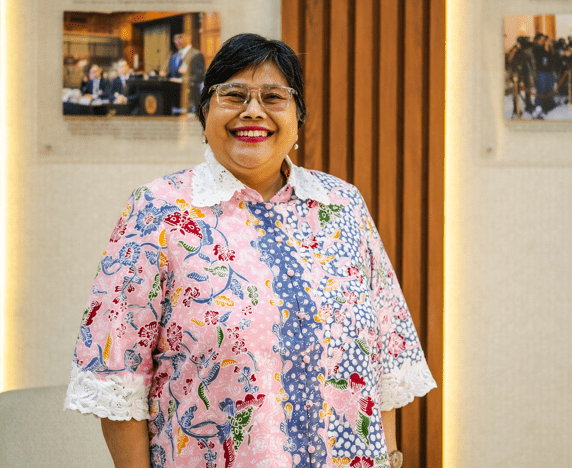
It was an unexpectedly personal conclusion to a conversation that had ranged from global geopolitics to trade, tourism and diplomacy.
And perhaps it also captured something about the diplomat herself.
Behind the formal role is someone who sees international relations not simply as agreements between governments, but as relationships between people.