

Scuba Diving in Indonesia: A Diver’s Guide to the World Beneath Our Islands
From the spectacular reefs of Raja Ampat to the strange and wonderful critters of Lembeh, Indonesia offers almost every kind of diving imaginable.
There are places where you go diving because the water is beautiful.
And then there is Indonesia.
Here, diving can mean drifting alongside manta rays, descending a sheer coral wall, searching black volcanic sand for a tiny mimic octopus, swimming through enormous schools of fish, exploring a World War II wreck, watching turtles glide overhead — or simply hovering over a reef and discovering that the longer you look, the more there is to see.
For anyone living in Indonesia, one of the great privileges is that many of the world’s most celebrated dive destinations are right on our doorstep.
You don’t necessarily need to fly overseas for an extraordinary underwater adventure. In fact, the difficult part is often deciding where in Indonesia to dive next.
An Underwater Superpower
Indonesia is the world’s largest archipelagic nation, stretching thousands of kilometers across the equatorial Indo-Pacific. Its extraordinary geography places it at the heart of the Coral Triangle, the global center of tropical marine biodiversity.
The result is almost impossible to exaggerate.
Indonesia’s waters contain vast coral reef systems, mangroves, seagrass meadows, deep channels, volcanic underwater landscapes and some of the richest concentrations of marine life anywhere on Earth. Indonesia’s enormous coastline and its position between the Asian and Australian-Melanesian biological realms is the major reason for this diversity.
Today, Indonesia’s dive industry has become very sophisticated. Destinations such as Raja Ampat, Komodo, Wakatobi, Bunaken and Lembeh attract divers from around the world. There are established resorts, liveaboards, professional dive centers, conservation programs and operators catering to everyone from first-time divers to experienced underwater photographers and technical divers.
And yet Indonesia still feels like a country where you can keep discovering new underwater worlds.
That is perhaps its greatest attraction.
The Big Question: Where Should You Dive?
Indonesia does not have one “best” dive destination.
It has destinations that are best for different kinds of diving.
Want spectacular coral reefs? Raja Ampat.
Want mantas and dramatic currents? Komodo.
Want tiny, bizarre creatures? Lembeh.
Want walls and turtles? Bunaken.
Want muck diving and unusual marine life? Ambon.
Want a classic wreck dive? Tulamben.
Want remote, challenging diving? Alor or the Banda Islands.
Want a combination of reefs, mantas, turtles and island adventure? Derawan.
Want a quieter alternative to the famous names? Togean, Bangka, Flores, Sangihe or parts of Maluku.
That diversity is what makes diving Indonesia so addictive.
1. Raja Ampat – The Crown Jewel

If there is one destination that belongs on every serious diver’s bucket list, it is Raja Ampat. Located off the western tip of Papua, Raja Ampat consists of more than 1,500 islands, cays and shoals surrounding the major islands of Waigeo, Batanta, Salawati and Misool.
The numbers are extraordinary. Indonesia’s tourism authorities cite roughly 540 coral types, around 1,320 fish species and hundreds of mollusk species in the region. But numbers don’t really explain Raja Ampat. The experience is one of sheer abundance.
Healthy hard and soft corals cover the reef. Schools of fish seem to occupy every available piece of water. Turtles cruise over the reef. Manta rays visit cleaning stations. Tiny pygmy seahorses hide among sea fans.
And then there are the landscapes above the surface: limestone karsts, turquoise lagoons, jungle-covered islands and isolated villages.
Raja Ampat’s magic lies in the extraordinary combination of life and landscape found beneath and above the water. Its reefs are remarkably diverse and alive with huge numbers of reef fish, while encounters with manta rays, wobbegong and walking sharks, pygmy seahorses and turtles add to the sense of discovery. Dramatic underwater topography and nutrient-rich currents bring even greater concentrations of marine life, while above the surface, spectacular limestone islands, turquoise waters and untouched-looking landscapes complete the experience.
Classic sites include Cape Kri, Blue Magic, Manta Point, Sardine Reef, Arborek, Yenbuba, Friwen Wall and The Passage.
The Passage is particularly memorable but is not a casual drift for inexperienced divers. Currents can be strong and unpredictable, which is precisely why experienced divers find it so exciting.
Liveaboard or resort?
Both work.
A liveaboard makes sense if diving is the primary purpose of the trip and you want to cover a large geographical area.
A resort or homestay-based trip is better if you want to combine diving with village visits, hiking, photography and a slower experience.
Raja Ampat is also a good example of why conservation and diving are now inseparable. Marine protected areas cover a significant portion of its waters, and visitor contributions help support management and conservation.
Best for: Experienced divers, underwater photographers, reef lovers and anyone who wants to see what a truly rich tropical ecosystem looks like.
2. Komodo – Where Currents Create the Action

Komodo is very different from Raja Ampat. Here, the underwater environment is shaped by powerful tidal currents flowing between islands. For the diver, that can mean exhilarating drift dives, enormous schools of fish, reef sharks, eagle rays and manta rays.
Sites such as Castle Rock, Crystal Rock, Batu Bolong and The Cauldron are legendary among experienced divers. The currents are not something to underestimate. A site that looks perfectly calm on the surface can have significant current below. That is part of the attraction — but also why your guide’s briefing should be taken seriously.
Mantas
Manta encounters are one of Komodo’s great attractions.
The best period depends on where you dive and what you want to see. Komodo is essentially a year-round destination, but conditions and marine life shift seasonally. Northern sites tend to be particularly attractive during the drier months, while manta activity can be strong in the south during the wetter period.
For an all-round trip, the shoulder months can be especially appealing because you can combine good conditions with fewer crowds. And, of course, there is the bonus of spending time on the surface with one of Indonesia’s most famous inhabitants — the Komodo dragon.
Best for: Experienced divers, drift diving, mantas, sharks, pelagics and divers who enjoy a little adrenaline.
3. Lembeh Strait – Forget the Big Animals
If Raja Ampat is about abundance and Komodo is about action, Lembeh is about looking closely. Very closely.
Lembeh Strait in North Sulawesi is one of the world’s great destinations for muck diving and macro photography. The scenery may initially look underwhelming compared with Raja Ampat’s coral gardens.
Lembeh may initially seem less spectacular than Indonesia’s famous coral-reef destinations, with much of the seabed covered in volcanic sand. But look closely, and an extraordinary world begins to reveal itself. A seemingly empty patch of sand might conceal a frogfish, a flamboyant cuttlefish, a ghost pipefish, or a tiny pygmy seahorse. With a little more patience, you may discover a blue-ringed octopus, a mimic octopus or a bizarre nudibranch you’ve never encountered before. It is this incredible concentration of unusual and often perfectly camouflaged creatures that makes Lembeh a mecca for underwater photographers and macro enthusiasts, who return time and again for the thrill of discovering what is hiding in plain sight.
The strait is roughly 12 km long and around 1.2 km wide and has dozens of recognized dive sites. Indonesia’s tourism authority describes it as one of the world’s premier muck-diving destinations.
Lembeh teaches an important lesson about diving: You don’t need spectacular scenery to have spectacular diving.
Sometimes the best dive is the one where you spend 60 minutes looking at an area no larger than a dining table.
Best for: Macro photographers, critter lovers, underwater naturalists and divers who enjoy finding rather than simply seeing.
4. Bunaken – The Classic Wall Dive
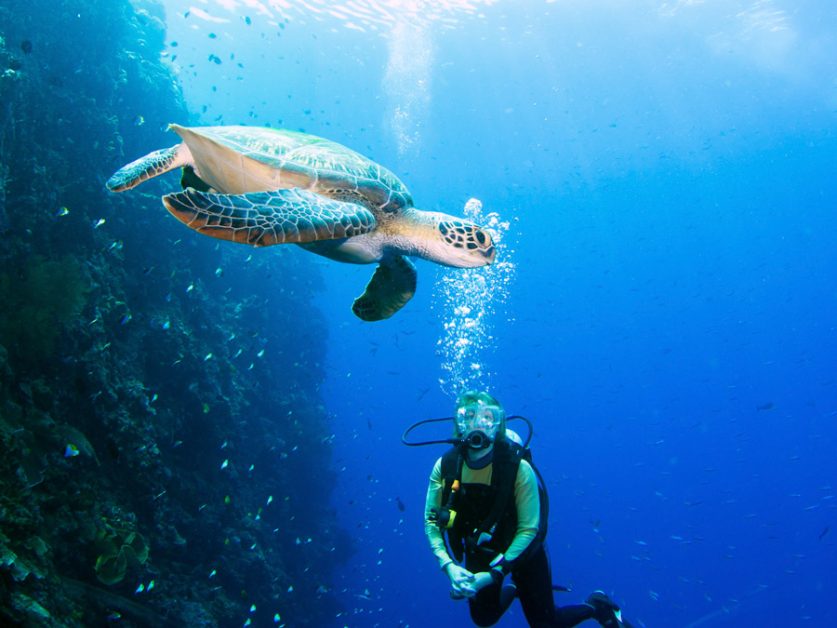
Bunaken was one of Indonesia’s pioneering international dive destinations and remains one of the country’s great classics. Located off Manado in North Sulawesi, Bunaken National Park covers more than 89,000 hectares, predominantly marine habitat.
Bunaken’s signature experience is wall diving, where descending over the edge of a reef can feel as though the seabed suddenly disappears into the deep blue. The walls are richly covered with sponges, sea fans, corals and an abundance of marine life, with turtles, schooling fish and colorful reef species often making an appearance. With around 390 recorded coral species, according to Indonesia’s tourism authority, the diversity is impressive. For divers who enjoy drifting alongside dramatic vertical walls with the blue stretching seemingly forever into the distance, Bunaken remains one of Indonesia’s classic dive destinations. Its convenient location just off Manado also makes it relatively easy to combine with a short diving getaway.
Best for: Wall diving, turtles, coral lovers and divers wanting a relatively accessible world-class destination.
5. Bali – Much More Than a Beginner’s Destination
For many Indonesians, Bali is where the diving journey begins as it has a huge diving infrastructure, plenty of dive operators and sites suitable for beginners. But experienced divers should not dismiss it.
Tulamben

Tulamben’s star attraction is the USAT Liberty, the famous World War II-era shipwreck resting just offshore. Widely regarded as one of the world’s most accessible wreck dives, the Liberty lies close enough to shore that divers can simply walk into the water and be exploring the historic wreck within minutes. Now covered in marine growth and surrounded by enormous schools of fish, the wreck offers an extraordinary underwater experience, while nearby sites such as Coral Garden and Noisy Reef provide a contrasting mix of reef life and underwater landscapes. One of Tulamben’s greatest appeals is precisely this accessibility — no expedition boat or complicated logistics are required; you can wake up, gear up and walk straight into the sea for a memorable dive.
Menjangan
On the opposite side of Bali, Menjangan offers a completely different experience. The island lies within West Bali National Park and is famous for its walls, coral formations, sponges and relatively sheltered diving. Walls descend to considerable depths and support an impressive variety of reef life.
Bali’s great advantage
Bali is particularly appealing because diving can easily be combined with everything else that makes the island such a popular destination. After a morning underwater, you can spend the afternoon exploring temples, enjoying the beaches, indulging in Bali’s food and wellness experiences, heading into the mountains or catching some waves, before ending the day with its vibrant nightlife. This variety makes Bali an excellent choice for mixed groups and families where not everyone is a diver, as there is plenty to enjoy both above and below the water.
Best for: Beginners, wreck lovers, mixed-interest groups and divers who want an easy combination of diving and tourism.
6. Wakatobi – Coral, Coral and More Coral

In Southeast Sulawesi lies Wakatobi National Park, one of Indonesia’s great coral destinations. The name comes from its four principal islands:
Wangi-Wangi, Kaledupa, Tomia and Binongko. The park covers approximately 1.39 million hectares and is recognized for its exceptional marine biodiversity. Indonesia’s tourism authorities cite around 590 fish species and 396 coral species in the park.
Wakatobi is particularly appealing to divers who appreciate healthy reef ecosystems rather than needing a checklist of large animals. Walls, slopes, coral gardens and channels provide an enormous variety of diving. Some sites can also have substantial current, making site selection and local knowledge important.
Best for: Coral lovers, underwater photographers, serious reef enthusiasts and divers looking for a destination where the reef itself is the star.
7. Alor – Wild, Remote and Not for Everyone
Alor is one of the destinations that experienced divers tend to talk about with a certain glint in their eyes.
Alor is more remote and adventurous than many of Indonesia’s better-known dive destinations, with conditions that can challenge even experienced divers. The water can be surprisingly cool at depth, while strong currents are a defining feature of many sites. Yet it is precisely these nutrient-rich waters and challenging conditions that help support an exceptional diversity of marine life, making Alor a rewarding destination for divers looking for something wilder and less travelled.
At Current Alley, for example, divers can encounter larger animals including sharks, tuna and giant trevally. Cathedral is known for dramatic changes in water temperature with depth.
Alor rewards divers who are comfortable with current and who appreciate destinations that have not been developed to the same degree as Bali or Komodo. It is also one of those places where the journey is part of the adventure.
Best for: Experienced divers, pelagic enthusiasts and those looking beyond Indonesia’s mainstream destinations.
8. Ambon – The Muck Diving Dark Horse
Ambon deserves far more attention from divers, particularly those who enjoy the thrill of discovering unusual marine life. Ambon Bay offers a fascinating mix of muck diving, colourful reefs and distinctive underwater terrain, with an impressive variety of creatures including frogfish, ghost pipefish, harlequin shrimp, mandarin fish, cuttlefish, blue-ringed octopuses, pygmy seahorses and stonefish. This is a destination where patience really pays off — slow down, listen to your guide and look closely, because the more carefully you search, the more you are likely to discover.
Best for: Macro photography, critter hunters and experienced divers who want something different.
9. Banda Islands – Diving Through History
The Banda Islands combine two of the great pleasures of travelling in Indonesia: extraordinary diving and a fascinating history. These tiny volcanic islands in Maluku were once at the heart of the global spice trade, and today their surrounding deep waters offer superb opportunities for encounters with pelagic marine life. Dive sites such as Batu Kapal, Gunung Api, Batu Belanda and Pulau Ai feature colourful reefs, dramatic walls, schooling fish and the possibility of encountering sharks. Banda is particularly appealing to divers who want their trip to feel like an expedition rather than a conventional beach holiday. Getting there takes more effort, and the infrastructure is relatively simple, but that remoteness is precisely what gives the Banda Islands their special charm.
10. Derawan, Sangalaki and Kakaban – The East Kalimantan Trio
The Derawan archipelago is another major marine destination, comprising islands including Derawan, Maratua, Sangalaki and Kakaban.
Sangalaki is particularly associated with manta rays and turtle conservation, while Kakaban is famous for its unusual jellyfish lake.
The wider region supports an impressive range of marine life, including turtles, mantas, dugongs, barracuda and reef fish. Indonesia’s tourism authorities cite hundreds of coral species and more than 870 fish species across the region.
This is another destination where diving can easily become part of a broader wildlife trip.
Best for: Mantas, turtles, island adventures and divers looking for something beyond Bali and Komodo.
And Then There Are the Others…
One of the great joys of diving Indonesia is that the list never really ends. There are also:
Togean Islands
Remote islands in the Gulf of Tomini offering relaxed, off-the-beaten-track diving.
Bangka
North Sulawesi’s Bangka Island is known for colorful reefs and impressive soft corals.
Sangihe and Talaud
Remote northern islands for divers who want exploration and fewer other boats.
Flores and Maumere
A mixture of reefs, volcanic landscapes and relatively little international diving traffic.
Sumba
Less developed as a dive destination but increasingly interesting for adventurous divers.
Roti and the Savu Sea
For divers prepared to travel further in search of less-visited sites and pelagic encounters.
The lesson is simple:
Don’t assume that the most famous destination is necessarily the best destination for you.
When Is the Best Time to Dive Indonesia?
This is where the old advice of simply saying “April to December” becomes too simplistic. Indonesia is enormous, and there is no single diving season for the entire country. The weather and underwater conditions vary dramatically between the Indian Ocean, Java Sea, Banda Sea, Flores Sea, Sulawesi and Papua. As a rough guide:
| Destination | Typical diving considerations |
|---|---|
| Raja Ampat | Conditions vary by area and season; plan around the specific region |
| Komodo | Diving is possible year-round; season affects currents, visibility and manta encounters |
| Bali | Diving is possible much of the year, with local variations |
| Bunaken | Generally accessible year-round, with local weather affecting conditions |
| Lembeh | Excellent year-round macro destination |
| Wakatobi | Generally favorable during the drier months |
| Alor | Best planned around local sea and wind conditions |
| Banda | Seasonal access is important and should be checked before booking |
| Derawan | Weather and sea conditions affect access and visibility |
The key point is:
Choose your destination first, then choose your dates.
Do not choose a month and assume the entire Indonesian archipelago will offer the same conditions.
How Much Experience Do You Need?
Indonesia offers something for almost every level of diver, from calm, accessible reef sites suitable for newly certified divers to challenging sites that demand considerable experience. However, certification level alone does not determine whether a diver is ready for a particular dive. Some of Indonesia’s most celebrated destinations, including Komodo, Raja Ampat and Alor, are known for strong currents and demanding conditions. A diver with 100 dives but little experience in currents may actually be less prepared for these sites than someone with fewer dives who has developed good current-diving skills and experience. The key is to choose dive sites that match your experience, confidence and conditions, rather than simply the number of dives in your logbook.
Before booking, ask the operator:
- What is the expected current?
- What is the maximum depth?
- Is this a drift dive?
- How are divers picked up?
- Do I need an SMB/DSMB?
- What certification or experience is required?
- How large are the groups?
- What emergency oxygen is carried?
- Where is the nearest recompression facility?
A good dive operator will be happy to answer these questions.
Choosing a Dive Operator
The quality of the operator can make or break a dive trip. Don’t choose solely on price. Look for an operator that:
- maintains its equipment properly
- conducts proper dive briefings
- limits group sizes appropriately
- has functioning emergency oxygen
- carries suitable communications equipment
- understands local currents and conditions
- has experienced guides
- follows marine park regulations
- takes reef protection seriously
- is transparent about what is and isn’t included
And don’t be afraid to ask about the boat. A beautiful Instagram account tells you very little about whether the operator runs a safe and professional diving operation.
Liveaboard or Land-Based Diving?
Both have their advantages.
Liveaboard
Liveaboard diving is ideal when diving is the main purpose of the holiday. Rather than travelling to and from a resort each day, you wake up at the dive site, enjoy breakfast, dive, have lunch and head back into the water — often repeating the cycle several times a day. The biggest advantage is access, allowing divers to reach remote reefs and sites that would be difficult or impossible to visit on a land-based trip. Destinations such as Raja Ampat and Komodo are particularly well suited to liveaboard itineraries, offering the opportunity to explore a much wider area and dive sites far beyond the reach of day boats.
Resort or land-based diving
A resort-based diving trip offers considerably more flexibility and a more relaxed pace. You can typically dive two or three times a day while still having plenty of time to rest, explore the island, meet local communities or enjoy other activities away from the water. It is also a better option for mixed groups or families, as non-divers can enjoy the destination without being tied to a boat’s diving schedule. Lembeh, Bunaken, Bali and many parts of Raja Ampat are particularly well suited to resort-based diving, giving you the freedom to combine serious time underwater with everything else the destination has to offer.
What Should You Pack?
One of the great advantages of diving in Indonesia is that you don’t necessarily need to travel with a suitcase full of dive gear. Most reputable dive operators provide the essential equipment as part of their dive packages, including tanks, regulators, BCDs, weights, wetsuits, fins and masks. If you are travelling between islands or heading off for a diving holiday, this makes it possible to pack surprisingly light. Many experienced divers still prefer to bring their own mask and dive computer for comfort and familiarity, along with a rash guard, swimwear, certification card and personal essentials. It is also worth carrying a few small spares, such as a mask strap or batteries, particularly when travelling to remote destinations.
And if you don’t have an underwater camera, don’t worry. Many dive operators now offer underwater photography or videography services for a small additional fee, allowing you to have your dives professionally documented without having to carry and manage your own camera equipment. For many divers, this is a great way to return home with memorable images of the experience while simply enjoying the dive.
Diving Safely in Remote Indonesia
The dive industry and emergency support have improved considerably in Indonesia, however, the geography means that some excellent dive sites are still far from major hospitals and hyperbaric facilities.
DAN has expanded its Indonesian emergency support and recompression chamber network, including additional facilities and local emergency support. DAN’s Indonesian emergency hotline is available 24/7 at 021-5085-8719 within Indonesia.
The fundamental rules remain:
- Dive within your training.
- Plan your dives conservatively.
- Respect currents.
- Don’t exceed your experience because everyone else on the boat is doing it.
And if you develop symptoms consistent with decompression illness, seek appropriate medical assistance immediately rather than attempting to “fix” the problem with another dive. DAN specifically warns against improvised in-water recompression. For remote liveaboard trips, dive insurance with appropriate evacuation and hyperbaric coverage is a very sensible investment.
Diving Is Also a Way of Discovering Indonesia. So, Where Should You Go First?
If you are new to Indonesian diving, here is my unofficial shortlist:
| If you want… | Start with… |
|---|---|
| Your first scuba experience | Bali |
| An easy wreck dive | Tulamben |
| Spectacular coral reefs | Raja Ampat |
| Manta rays | Komodo / Raja Ampat / Sangalaki |
| Sharks and pelagics | Komodo / Alor / Banda |
| Tiny weird creatures | Lembeh / Ambon |
| Wall diving | Bunaken / Menjangan |
| Macro photography | Lembeh / Ambon |
| Remote adventure | Alor / Banda / Togean |
| A luxury dive holiday | Raja Ampat / Wakatobi |
| A liveaboard adventure | Raja Ampat / Komodo / Banda |
| Diving plus culture and food | Bali / Ambon / Banda |