

September’s Reshuffle: Two New Chairs in Jakarta, a Bank That Now Collects Your VAT, and Eight Days to the GloBE Gate
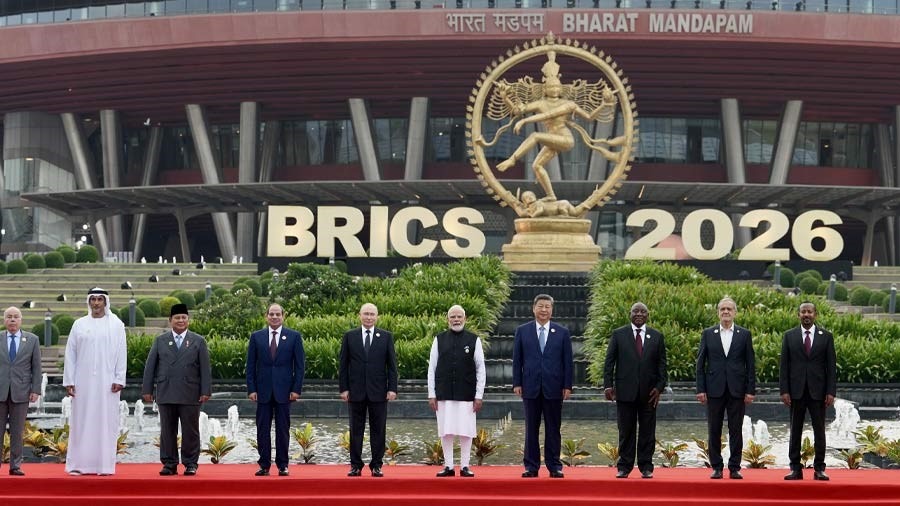
Bpk. Prabowo sat in New Delhi on 12 September as India chaired BRICS. At home, Indonesia changed its central bank governor and its finance minister inside eight weeks — while three compliance clocks kept running. Plus: SPP-TDLN turned the payment rail into a VAT collector on 10 September, GloBE registration closes ~30 September, and the 0.5% story most people are telling is wrong.
On 3 September, the tax office published the user manual explaining how to register as a GloBE Taxpayer. The deadline to register is 30 September.
Twenty-seven days, for the filing that decides where a multinational group’s top-up tax is assessed and who answers for it. Sit with that sequencing for a moment, because it is the honest texture of this month: the instruments were all announced earlier in the year, the operating detail arrived late, and the dates did not move to accommodate anybody.
August was the month the corridor counted its trade. September is the month Jakarta changed the people holding the pen — two of the most consequential financial appointments in the country — and then, without pausing, switched on a system that puts your bank between you and every foreign software subscription your Indonesian entity pays for. If July was the handshake and August was the ledger, September is the wiring diagram.
| REGISTRATION CLOSES · GloBE TAXPAYERS · ~30 SEPTEMBER 2026 Under PER-6/PJ/2026 (issued 4 May 2026, implementing PMK-136/2024), an in-scope constituent entity must apply for GloBE Taxpayer status through the Coretax taxpayer portal within nine months of the end of its first GloBE year — 30 September 2026 for calendar-year groups whose first GloBE year was 2025. The scope test is consolidated group revenue of at least €750 million in at least two of the four preceding fiscal years. Decline to apply and the KPP may add the status ex officio; PER-6 expressly contemplates supervising entities that have not registered. First-year top-up tax must be settled before the return can be submitted. Separately, the PMK 44/2026 transition window for brevet-holders acting as kuasa still closes 31 December 2026 — roughly seventy working days from now. |
New Delhi Seats Ten; Jakarta Changes Two
The set-piece was the 18th BRICS Summit at Bharat Mandapam, New Delhi, on 12–13 September, under India’s 2026 chairship and the theme “Building for Resilience, Innovation, Cooperation and Sustainability”. President Prabowo Subianto attended — Indonesia’s first leaders’ summit since joining as a full member in January 2025 — and joined the restricted session on inclusive global governance. Local-currency trade and cross-border payment systems were on the agenda, which is the part of the communiqué that touches this readership.
The consequential news, though, was domestic, and it went almost unremarked in the Indian business press. Indonesia replaced the two officials who matter most to anyone moving money through this corridor.
On 27 July, Perry Warjiyo’s resignation as Governor of Bank Indonesia was accepted, roughly two years before his second term expired. Senior Deputy Governor Destry Damayanti ran the bank as acting governor, and on 1 September the DPR confirmed her as Governor for 2026–2031 — the first woman to lead BI — alongside Aida S. Budiman as Senior Deputy Governor and Solikin M. Juhro as Deputy Governor. Two weeks later, on 14 September, President Prabowo swore in Suahasil Nazara as Finance Minister under Keppres 97P/2026, replacing Purbaya Yudhi Sadewa after twelve months. Three finance ministers in a year — Sri Mulyani, Purbaya, Suahasil — and a new central bank board, inside eight weeks.
Read that operationally rather than politically. Two commitments this dispatch has tracked all year sit in exactly those two offices. The end-2026 QRIS–UPI deadline is Bank Indonesia’s to deliver, and it now belongs to a Board sworn in during September, inheriting a rupiah that traded around Rp18,005 to the dollar at end-July — some 8% weaker year to date — and a permanent 10% US tariff on Indonesian goods in force since 24 July. The Coretax–GloBE–PMK 44 compliance stack is the Ministry of Finance’s, and a new minister has inherited a September deadline he did not set.
Suahasil’s first public signal, on 18 September, was that valid tax refunds will be paid. Worth reading against PMK 28/2026, which from 1 May tightened the accelerated-refund criteria and revoked PMK 39/PMK.03/2018, converting an administrative facility into one reserved for taxpayers with a demonstrably clean compliance record. If your PT has a VAT refund sitting in the queue, October is the month to test that statement rather than assume it. A ministerial sentence is not a regulation, and the regulation moved the other way four months ago.
The Compliance Desk: Your Bank Is Now a Tax Collector
On 10 September the DGT switched on SPP-TDLN — the collection system for VAT on foreign digital transactions — beginning with the four Himbara state banks and widening in stages. The legal chain is Presidential Regulation 68/2025, which designates PT Jalin Pembayaran Nusantara, a state-owned payments-technology subsidiary, as system operator, and PMK 49/2026, promulgated 20 July 2026, which sets out the mechanics across 24 articles.
Strip the acronyms away and the design is unusually direct. Card issuers — banks and non-bank payment institutions — are appointed by the DGT as “other parties” (pihak lain) after a development period and a sandboxed stabilisation test. When an Indonesian cardholder pays a foreign digital vendor, the issuer passes the transaction data to the operator — reference number, value, currency, merchant identity, timestamp, payment details — before authorisation. The operator confirms whether VAT applies; the VAT falls due at the moment of that confirmation; and the issuer collects it using the formula 11/111 of the VAT-inclusive payment value. The issuer remits to the operator within seven days of confirmation, and the operator to the state treasury within seven days of that.
Three things follow, and only the first has made the headlines.
First, this is a second net, not a replacement. Transactions where VAT has already been collected by an appointed PMSE collector are out of scope. The target is everything that slipped past the PMSE list — and the Indonesian press has been refreshingly blunt about the examples: Netflix, Canva, PUBG. For an Indian software or platform business selling into Indonesia without a PMSE appointment, the practical effect is that Indonesia has stopped asking you to collect and started collecting at the payment rail instead. Your pricing page did not change. Your customer’s landed cost did.
Second — and this is the line to read twice — the issuer’s collection document is treated as equivalent to a tax invoice, and the VAT shown on it is creditable as input tax on two conditions: that the customer’s registered email address or telephone number appears in DJP’s administration, and that the ordinary input-tax crediting rules are met (Article 10(6), PMK 49/2026). Now picture how foreign software is actually bought inside a mid-sized PT. A manager’s work email, sometimes a personal one. A card in a director’s name. A subscription nobody in finance sees until the statement arrives. Under that arrangement the VAT is collected and is not creditable — a permanent cost, quietly, on every cloud, design, analytics and collaboration tool the company runs. It is the corporate equivalent of the household habit of putting the electricity bill in whichever family member’s name was standing nearest the counter: fine for years, expensive the day it matters. The remedy is administrative and takes an afternoon.
Third, the reconciliation is still yours. Bill statements now stand in for tax invoices, foreign-currency amounts must still be converted at the KMK rate, refunds for cancelled or wrongly collected transactions run back through the issuer to the operator, and the risk of double collection between PMSE and SPP-TDLN sits with the taxpayer. The administrative burden has moved into the banking system. The liability has not moved anywhere.
| “The administrative burden of taxing foreign software has moved into the banking system. The liability has not moved anywhere.” |
The 0.5% Story Most People Are Telling Wrong
A version of this month’s tax news is circulating that says PP 20/2026 revoked the 0.5% final tax for PT, CV and firma. It is close enough to be quotable and wrong in two ways that cost money.
PP 20/2026, effective 22 April 2026 and amending PP 55/2022, did not abolish the facility. It narrowed the eligible badan perimeter: ordinary PT (including PT PMA), CV, firma and BUMDes can no longer be new users, while entities already inside keep their remaining statutory term — up to three years for a PT, four for a CV or firma. The facility remains indefinitely for individuals, single-shareholder Perseroan Perorangan and koperasi with turnover up to Rp4.8 billion. So the question for your entity is not “has it been revoked?” but “how many months of term remain, and what is the switch date?” Those are very different conversations with a board.
The second error is the more expensive one. Article 31E is routinely described as an 11% rate for companies with turnover up to Rp50 billion. It is a 50% reduction of the 22% rate applied only to the portion of taxable income attributable to the first Rp4.8 billion of gross turnover — not a blanket rate across the whole profit. A 2027 budget built on 11% throughout will be wrong in the direction that hurts.
| Instrument | The date that matters | What it means for Indo-Indian entities |
| PER-6/PJ/2026 — GloBE / Pillar Two | ~30 Sep 2026 — GloBE Taxpayer registration via Coretax. Annual GloBE / DMTT return four months after year-end (two-month extension available in year one). GIR for FY2025 by 30 Jun 2027. | Self-assess the €750m test on two of the four preceding fiscal years. Allocate GIR responsibility in writing between parent and PT. Every GloBE taxpayer files a DMTT return whether or not DMTT is owed. Top-up tax is payable before the return can be filed. |
| Perpres 68/2025 + PMK 49/2026 — SPP-TDLN | Live 10 Sep 2026, Himbara banks first, widening in stages. PMK promulgated 20 Jul 2026. | Inventory every foreign digital subscription. Move each to a company email and company card, and confirm that email sits in DJP’s administration — otherwise the VAT collected at the rail is not creditable (Art. 10(6)). |
| PP 20/2026 — UMKM final tax | In force 22 Apr 2026; amends PP 55/2022. | Not a revocation. Confirm each entity’s remaining term (PT 3 years, CV/firma 4) and the switch date to 22% PPh Badan with full accrual pembukuan. Art. 31E is not a blanket 11%. |
| PMK 44/2026 — Tax representation | 31 Dec 2026 — close of the transition window for brevet / tax-education holders acting as kuasa. | Around seventy working days remain. The SKT route is still not practically open, so the reliable path is moving the mandate to a licensed consultant before the window shuts. |
| PMK 28/2026 — Refunds | From 1 May 2026; revokes PMK 39/PMK.03/2018. | Accelerated refund narrowed to taxpayers with a strong compliance record. Re-test any pending claim against the new criteria before relying on the Minister’s 18 September assurance. |
The five instruments shaping the September–December 2026 compliance desk.
Trade Pulse: The Customs Line Is Where the Enforcement Shows
The Ministry of Finance reported customs and excise receipts of Rp210.2 trillion to 31 August 2026, up 7.8% year on year from Rp194.9 trillion and equal to 62.6% of the APBN 2026 target. The composition is more instructive than the headline: excise Rp148.7 trillion (up 3.2%), import duty Rp36.4 trillion (up 13%, on import volume and exchange-rate movement), and export duty Rp25.1 trillion (up 34.4%, on crude palm oil price and volume). The shape of the year matters too — receipts contracted 14.0%, 14.7% and 12.6% in January, February and March before turning positive in April and climbing to 6.7% by July.
Two readings for this corridor. Import duty up 13% on volume and FX, with no tariff change behind it, is a landed-cost line for every Indian exporter shipping into Indonesia; if your 2026 pricing assumed a stable rupiah, the arithmetic has already moved against you. And enforcement is the other half of the story: illegal-cigarette actions rose 9.8% to 13,151, while the volume seized rose 60.2% to roughly 1.1 billion sticks. Far bigger seizures per action is what a customs service looks like when its targeting data has improved, not merely when it has more inspectors. Anyone importing on thin documentation should assume the same targeting logic is being pointed elsewhere.
On trade policy, the sequencing set out in Jaipur last month holds. Indonesia’s AITIGA liberalisation rate sits at 41.9% against an agreed 80% market-access target, with phased offers covering roughly 57% of that target tabled by July; the next review round is scheduled for Jakarta in October, with substantial conclusion targeted the same month. Minister Piyush Goyal’s position on the proposed Indonesia–India PTA was that bilateral discussions be launched at ministerial level once AITIGA has progressed substantially — which keeps the PTA a 2027 negotiation, not a 2026 one. H1 2026 bilateral trade stands at US$11.89 billion: US$9.28 billion out of Indonesia, US$2.60 billion in from India.
| COMMUNITY CHALLENGE · SEPTEMBER 2026 September changed the names on two doors and the plumbing behind a third. Before your next board paper, run this three-question test on your Indonesian operation. |
- Can I name every foreign digital subscription my Indonesian entity pays for, and which company email and which card each one sits on? If I cannot, I am probably paying non-creditable VAT on all of them from this month.
- Has a named person actually pressed the button on GloBE registration inside Coretax — or am I relying on a group email thread in which someone said they were handling it?
- Which of my Indonesian relationships — bank, ministry, regulator — depended on a person rather than a process? Two of the country’s most senior financial posts changed hands in eight weeks. Mine is a question every reader should be able to answer before the next one does.
Reply to this dispatch with the answer that surprised you most — those that resonate will be featured (anonymously) in October.
Sampai jumpa di bulan depan. (See you next month.)
Quick Compliance Checklist · October 2026 Lookahead
Ten action items to clear before end-October 2026:
| Tax & Coretax | Corporate & Treasury |
| ▢ Complete GloBE Taxpayer registration in Coretax before 30 September; confirm first-year top-up tax is funded — payment precedes filing (PER-6/PJ/2026). | ▢ Recompute any budget built on a blanket 11%: Art. 31E applies only to income attributable to the first Rp4.8 billion of turnover. |
| ▢ Inventory every foreign digital subscription; move each to a company email and company card registered in DJP’s administration, or the SPP-TDLN VAT is not creditable (PMK 49/2026 Art. 10(6)). | ▢ Re-test any pending VAT refund against PMK 28/2026 criteria before relying on the Minister’s 18 September statement. |
| ▢ Check for double collection between PMSE and SPP-TDLN on the same vendor; retain issuer bill statements as tax-invoice equivalents. | ▢ Model your tariff lines against the AITIGA 80% target ahead of the October round in Jakarta; the ID-IN PTA follows it, not precedes it. |
| ▢ Confirm each ordinary PT/CV’s remaining 0.5% term and its switch date to 22% PPh Badan with full pembukuan (PP 20/2026). | ▢ Do not build the 2027 plan on a live QRIS–UPI rail — and do not expect it to settle B2B when it lands. Price INR/IDR reference-rate flows with your bank now. |
| ▢ Move every kuasa mandate to a licensed consultant — roughly seventy working days to 31 December 2026 (PMK 44/2026). | ▢ Run a privileged-access review over every Coretax e-certificate and every corporate card now inside the SPP-TDLN data flow. |
|
ABOUT THE AUTHOR CA Loganathan Anandan, FCA · CISA · CDPSE · CFE Loganathan is President Director of PT JCSS Management Consulting, with two decades of advisory experience across the India–Indonesia–Singapore corridor. His practice spans cybersecurity, AI strategy, cross-border tax, regulatory compliance, and corporate integration — with a focus on bringing Indian frugal-innovation discipline into Indonesia’s mid-market. Connect: https://www.linkedin.com/in/caloganathan/ |