


Setting Up a Company in Indonesia: A Practical Guide for Indian Entrepreneurs
By Asif Hayat Malik FCCA
Over the years I have helped many foreign entrepreneurs set up their companies in Indonesia, and Indian founders are among the most well prepared. They usually arrive with a clear business plan and a good sense of the market. Even so, the same few questions come up again and again, and the same few mistakes cost people time and money.
This article sets out what I tell every Indian client at our first meeting. Planning has always been the most important part of any task, and setting up a company is no exception: plan first, understand the rules, then act.
1. Decide what you actually need
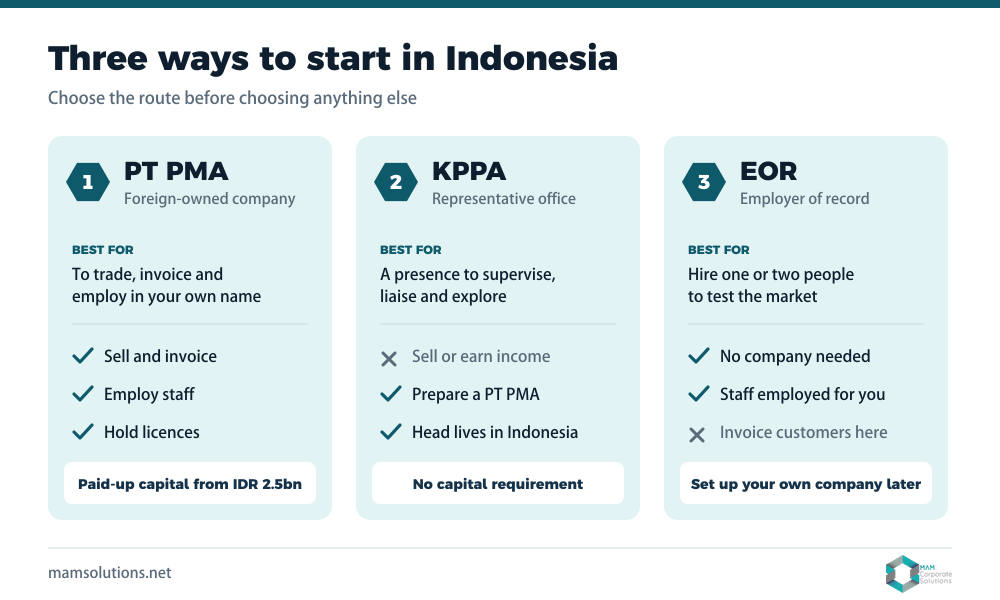
Before choosing a structure, be clear about what you want to do in Indonesia. There are three common routes:
- A foreign-owned company (PT PMA). This is the right choice if you will sell, invoice customers and employ staff in Indonesia in your own name.
- A representative office (KPPA). This suits a company that only needs a presence: to supervise, liaise and explore the market. It cannot trade or earn income here.
- An employer of record (EOR). If you want to hire one or two people to test the market before committing to a company, an EOR employs them on your behalf. Some clients start this way and set up their own company later.
Choosing the wrong route is expensive to undo, so this decision deserves time.
2. Your business activity decides almost everything
Every company in Indonesia is registered under one or more business activity codes, known as KBLI. The code you choose decides:
whether a foreign shareholder can own 100% of the company, or whether foreign ownership is limited;
which licences you need, depending on how risky the government considers the activity; and
how much you must invest.
The most common mistake I see is choosing a code because it makes the licence easier, rather than because it describes the business. It passes registration, and the problem surfaces later, when a bank, an auditor or a customer asks questions. Correcting it then means amending the company’s deed, and sometimes its licences.
Location matters as much as the activity, particularly for manufacturing. One of our clients wanted to build a chemicals manufacturing plant in Indonesia. A manufacturing business needs careful thought about where it is set up, because the location decides which permits apply and which incentives are available. We advised them to set up in a special economic zone (Kawasan Ekonomi Khusus, or KEK) with an industrial zone, so that they could take advantage of the tax incentives offered to businesses operating there.
3. Understand the capital rules early
This is the point that surprises Indian founders most. Under the investment ministry’s current regulation (BKPM Regulation 5 of 2025), a PT PMA must have:
- issued and paid-up capital of at least IDR 2.5 billion, paid into the company’s bank account; and
- a planned investment of more than IDR 10 billion for each business activity at each location, excluding land and buildings.
The paid-up capital is not a deposit that sits idle. It must stay in the company for the first twelve months, but it can be spent on running the business: rent, salaries, equipment and so on. The IDR 10 billion is the investment you plan to make over time, and it is reported to the government as the business grows.
There are some variations by sector, so the exact figure for your business should be checked before you commit.
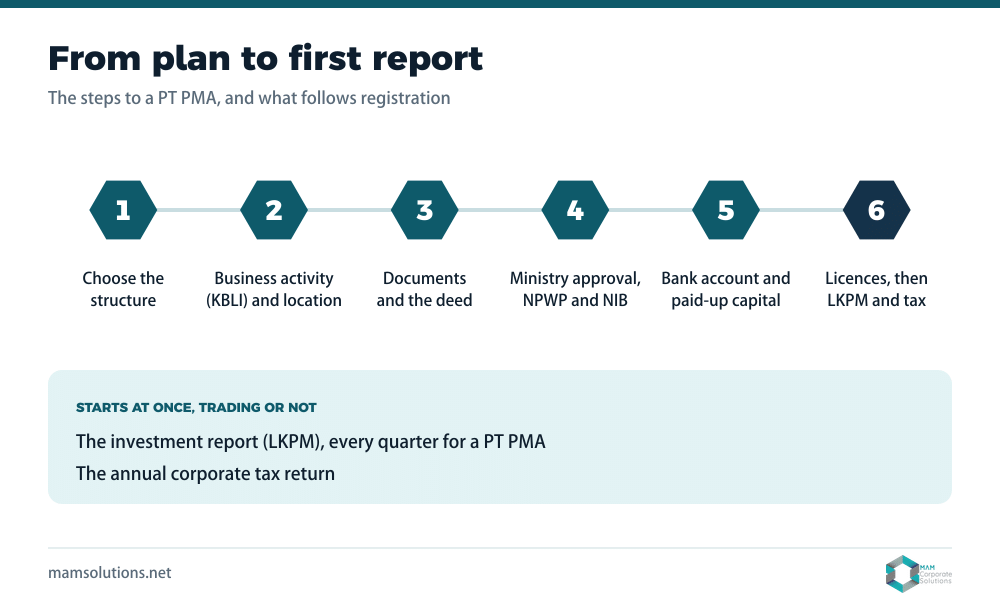
Many business owners believe that the full capital has to be invested from the very start. This is a misconception. We always advise clients to meet their capital commitment as soon as they can, but not having injected the whole amount does not immediately lead to the closure of the business. What matters is that the company files its investment report (LKPM) every quarter and keeps the investment ministry informed of its progress. This shows that the business is real and committed to its investment. In reality, not every business injects its whole capital in one go, and this is understandable.
4. Prepare your documents in India
For an individual Indian shareholder, the process is simple: a passport copy and a power of attorney are normally enough, and the deed of establishment can be signed in Indonesia on your behalf.
If the shareholder is an Indian company, its articles of association and related documents must be apostilled. Both India and Indonesia are parties to the Apostille Convention, so the apostille is obtained in India from the Ministry of External Affairs, and embassy legalisation is not needed. Start this early, because it is often the step that takes the longest.
You will also need to decide early on:
- the company name (Indonesian names must follow specific rules);
- who will be the directors and commissioners;
- the business address, which can be a virtual office for some activities; and
- the shareholding split, if you have partners.
5. Directors and your own stay permit
A foreigner can be a director or commissioner of a PT PMA. Nothing in the Company Law requires a director to be Indonesian. What matters is the permit: a foreign director who will work in Indonesia needs a limited stay permit, known as a KITAS.
There are two main routes. A director employed by the company holds a work permit and KITAS. A shareholder whose shares are worth at least IDR 10 billion can apply for an investor KITAS instead. Which one suits you depends on your shareholding and your role, so this is worth discussing before the company is set up, not after.
6. Opening the bank account
Once the company is registered, it needs a corporate bank account to receive the paid-up capital. Indonesian banks will ask for the full company file (the deed, the Ministry of Law approval, the tax number and the business identification number) and for details of the shareholders and where the funds come from. Having these documents ready, and consistent with each other, makes the process much smoother.
7. After registration: the obligations start immediately
Many founders think the work is finished once the company is registered. In fact, two obligations start straight away, whether or not the company is trading:
- the investment report (LKPM), filed online with the investment ministry; and
- the annual corporate tax return.
Once you start trading and hiring, monthly tax returns, payroll tax and social security (BPJS) contributions follow. If the company is registered for VAT, a VAT return is due every month.
The question Indian business owners ask me most often is about sending profits home: what tax applies when dividends are paid to a shareholder in India? Under Indonesian law, dividends paid to a shareholder abroad are subject to withholding tax of 20%. The tax treaty between India and Indonesia reduces this to a maximum of 10% where the shareholder receiving the dividends is resident in India (Article 10 of the 2012 agreement). The lower rate applies only if the Indian shareholder’s certificate of residence, in the form the Indonesian tax office requires, is in place before the dividend is paid. So this should be planned well before the first dividend, not after it.
My advice
Indonesia is a large and growing market, and I have seen many Indian businesses do well here. Those that succeed have one thing in common: they took the time to plan. They chose the right structure and the right business activity, understood the capital commitment, and kept their compliance up to date from the first month.
The rules are clear once you know them. Take advice before you sign anything, prepare your documents early, and treat compliance as part of running the business rather than an afterthought.
 Asif Hayat Malik FCCA About the authorAsif Hayat Malik FCCA is the CEO of MAM Corporate Solutions, based in Jakarta. A Pakistani-born chartered certified accountant, he helps foreign investors set up and run companies in Indonesia. MAM takes care of company formation, payroll, employer of record services and tax compliance for clients across the country. Website: mamsolutions.net |