

India was the largest buyer at Trade Expo Indonesia 2026 by value and by headcount. Nine days earlier Indonesia’s own palm association said exports will fall 4.5 million tonnes. Plus: MSCI’s standalone proposal, the rupiah through 18,000, and two central banks walking in opposite directions.
On 24 September India cut the basic customs duty on crude palm oil from 10% to 5%. On 9 October Indonesia’s own palm oil association said national exports will fall by 4.5 million tonnes next year because the B50 biodiesel mandate will eat the barrel at home.
India has made it cheaper to buy a commodity that is about to be rationed — not by the market, but by Indonesian energy policy. Both governments acted rationally. Nobody coordinated. That is the corridor in one month: two capitals optimising separately, and an importer in Chennai discovering in January that the duty saving was the smaller number.
Last month the corridor counted. This month it collided. Trade Expo Indonesia closed on 18 October with India as the single largest buyer country — first by transaction value and first by buyer headcount. The week before, the fifteenth AITIGA Joint Committee had met at the ASEAN Secretariat in Jakarta and quietly moved the finish line to January 2027. And in between, MSCI proposed to take Indonesia out of the emerging-market universe altogether.
The Tangerang Count
The 41st Trade Expo Indonesia ran 14–18 October at ICE BSD, Tangerang: US$22.94 billion of transactions against a US$17.5 billion target, 1,873 exhibitors and roughly 9,600 foreign buyers from 151 countries. India led by transaction value, ahead of the Netherlands, Bangladesh, the UAE and Japan, and by buyer count, ahead of Malaysia, China, Saudi Arabia and Taiwan.
Two cautions before anyone puts that in a deck. Kemendag published the ranking but not the country-level values, so “India was the largest buyer” is a rank, not a number. And the headline categories transacted — food and beverages, jewellery, wood products, agricultural goods — are a fair’s mix, not the bilateral export structure. The Minister said as much himself.
The structural number landed the day after. On 15 October, at the same fair, Trade Minister Budi Santoso met an Indian business delegation and put January–August 2026 bilateral trade at US$16.62 billion: Indonesia exporting US$12.81 billion, importing US$3.81 billion, surplus US$8.99 billion.
Run the ratio across three readings and the story this column has tracked since August is now a trend. Indonesian exports to India per dollar imported: 3.78:1 in calendar 2025, 3.57:1 at the half year, 3.36:1 through August. Annualise the eight months and India’s sales into Indonesia are running about 18% above 2025 against roughly 5% the other way. The surplus is still enormous. The derivative has changed sign.
The composition problem has not. The 2025 top-five still reads: Indonesia sends coal, palm oil, stainless steel, industrial fatty acids and artificial corundum; India sends back buffalo meat, peanuts, cargo vehicles, tractor parts and raw tobacco. Groceries and gearboxes, still. What changed this month is that the Indonesian trade minister raised it himself — asking for Indian investment in automotive, furniture and rare earths, and naming Indian certification requirements as the barrier on the other side. Certification, not tariffs. That is a technical-barriers conversation, and technical barriers are where corridor advisory firms earn their fees.
The August edition flagged October as the target for substantial conclusion of the AITIGA review. It did not conclude. The 15th Joint Committee met 6–9 October at the ASEAN Secretariat in Jakarta, directed all sub-committees to “expedite pending chapters” with “time-bound deliverables” — the language of a negotiation that has slipped and knows it — and set the next meeting for January 2027, in India. The AITIGA tariff schedule is therefore not a 2026 planning input; it is a 2027 one at the earliest, and the India–Indonesia bilateral PTA, always sequenced behind it, moves further right with it.
Trade Pulse: The Barrel and the Duty
The most consequential thing that happened to the corridor this month was not signed by anyone. It was two unconnected decisions about cooking oil.
On 23 September India issued Notification No. 31/2026-Customs, effective 24 September: basic customs duty on crude palm and crude soybean oil from 10% to 5%, crude sunflower to nil, with the refined lines cut to 27.5% and 22.5%. One caution: the notification names tariff serial numbers, not oils, so the mapping is the press’s. Confirm it against the principal notification before you quote it to a client.
The effect was immediate and visible. India’s September palm oil imports hit 817,884 tonnes, a seven-month high, up 4.5% on August, while sunflower oil collapsed 32% to 108,837 tonnes — the lowest since April 2022 — as Black Sea supply failed. Refiners substituted into palm ahead of the festive season. Indonesia and Malaysia were the beneficiaries without lifting a finger.
Then, on 9 October in Jakarta, GAPKI put numbers on the other side of the trade. With B50 — launched on 9 July 2026 — running its first full calendar year in 2027, the association projects palm oil exports falling from 31.0 million tonnes in 2026 to 26.5 million in 2027, down 14.5%, as biodiesel alone takes 17.4 million tonnes against 14.7 million and El Nino trims production to 56.6 million tonnes. Projected closing stock: about 2.7 million tonnes, against an ideal 3.5–4.0 million.
The arithmetic that matters to an Indian buyer: the 4.5 million tonnes Indonesia expects to withdraw from the export market is about five and a half times India’s entire palm oil import for September. These are an industry association’s projections, not a government forecast. But the policy direction is not in dispute, and two further changes land on 1 January 2027: DSI becomes the sole exporter of record for palm oil (in reporting-only transition since 1 June 2026), and OJK takes over supervision of the BMKS commodity exchange.
So the planning question for any Indian edible-oil, FMCG or feed business is not “what did the duty cut save me this quarter?” It is: who is my counterparty after 1 January 2027, what does single-gate export mean for my contract of record, and have I secured tonnage or only price? A duty saving of five percentage points is worth very little against a supply curve that moves.
| “India cut the palm duty on 24 September. Indonesia’s own industry said on 9 October that exports will fall 4.5 million tonnes. The duty saving is five percentage points. The supply curve is worth more than that.” |
Capital Pulse: The Month Jakarta’s Market Broke
On Thursday 15 October, MSCI launched a consultation proposing to reclassify the MSCI Indonesia Indexes from Emerging Market to Standalone Market status. The stated grounds are not macroeconomic: persistent opacity in shareholding structures, suspected coordinated trading behaviour, and no evidence of meaningful enforcement, against an index freeze running since January 2026.
The supporting data is the uncomfortable part. Indonesia’s weight in the MSCI Emerging Markets Index was 0.43% at 30 September 2026, against 1.16% at the end of 2025; constituents fell from 18 to 9; free-float index capitalisation from US$119.14 billion to US$53.36 billion, a 55% decline in nine months. Feedback closes 30 April 2027, decision by 30 June 2027. Nothing is decided. FTSE Russell, separately, kept Indonesia at Secondary Emerging.
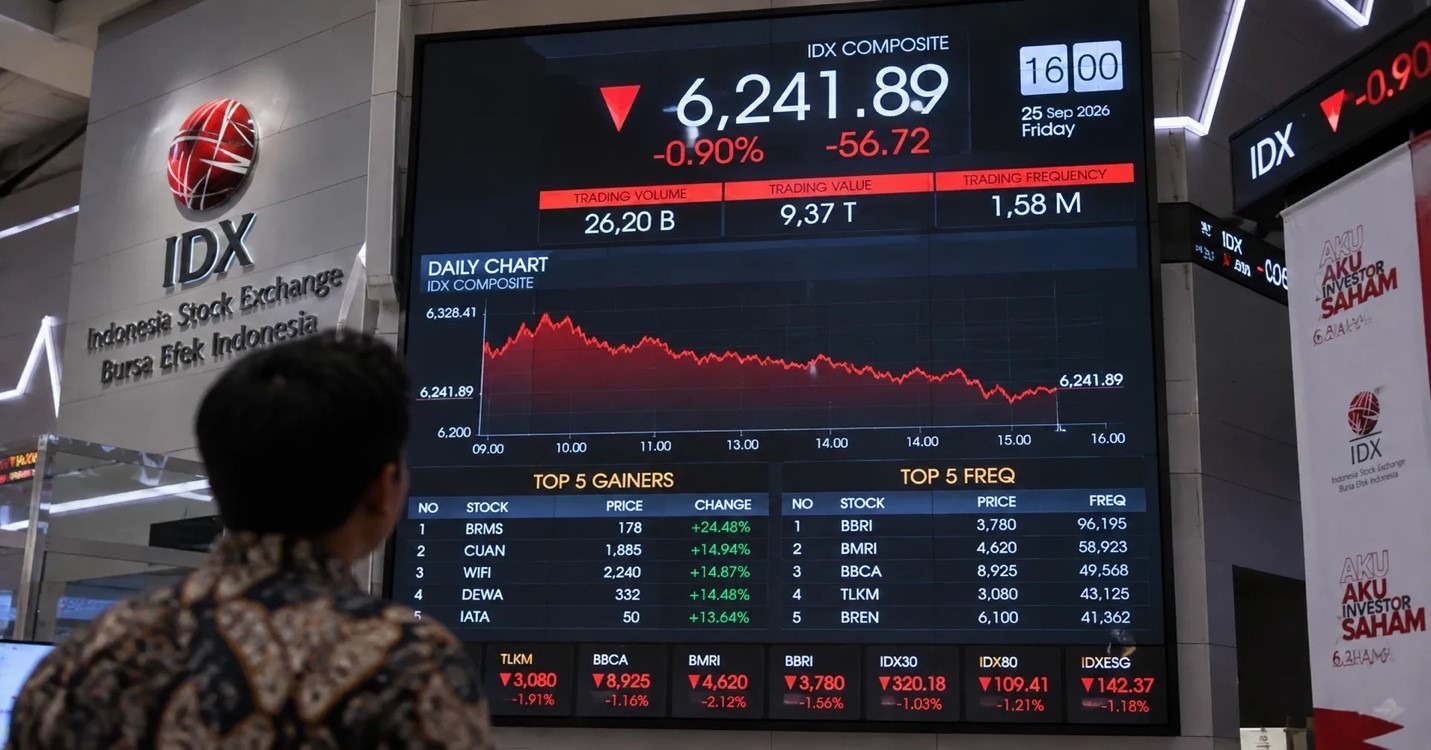
The market did not wait. On Friday 16 October the IHSG opened down 8.01% at 5,393.92, triggering a trading halt; the rupiah opened at 18,021 per US dollar, back through the level it first breached on 4 June 2026. Bank Indonesia confirmed intervention across offshore NDF, domestic spot and DNDF, plus secondary-market purchases of government securities, with reserves at US$146.3 billion at end-September.
Now put two dates side by side. On 29 September the DPR passed the 2027 state budget — spending Rp4,106.3 trillion, deficit 2.4% of GDP, growth 6.0% — on an exchange rate assumption of Rp17,500 per US dollar. Seventeen days later the currency printed 18,021, about 3.0% weaker than the budget’s own assumption, in the first month of the fiscal planning cycle. That gap is not a crisis. It is a line item, and it sits under every import-dependent subsidy in that budget.
Against that, Jakarta did not sit still. Danantara’s Chief Investment Officer said the fund will deploy around US$5 billion into Indonesian companies over six to nine months — a commitment made before the MSCI news, not in response to it. On 5 October the government rolled out a Rp31 trillion Q4 package of rice, wage subsidy, Article 21 relief and housing VAT borne by government; on 18 October it marked two years in office with 26 downstreaming projects worth Rp225 trillion routed through Danantara — a pipeline, note, not a completion report.
Two Central Banks, Opposite Directions
This is the cleanest divergence the corridor has produced in years, and treasury teams running both books should have it on one page.
Bank Indonesia held the BI-Rate at 5.75% on 23 September, with the deposit facility at 4.75% and lending at 6.50%, under Governor Destry Damayanti. Indonesian headline inflation in September was 3.28% year on year, core 2.84% — comfortably inside the 2.5% +/- 1% band.
The Reserve Bank of India went the other way. On 7 October the MPC raised the repo rate 25 basis points to 5.50% — its first hike since 2023 — and moved the stance from neutral to calibrated tightening, projecting FY2026–27 growth at 7.1% and CPI at 5.2%. September CPI then came in at 5.54%, up from 4.83% in August, with food inflation at 7.74%.
The consequence, in one line: Indonesia is holding a real policy rate of roughly plus 2.5 percentage points over current inflation, while India has just tightened into a real policy rate of roughly minus 0.04 — essentially zero. One central bank is defending a currency with a positive real cushion it already had. The other is raising rates and still not ahead of prices. If your INR–IDR exposure is unhedged on the assumption that rate differentials will do the work, that assumption expired on 7 October.
The Compliance Desk: One Correction, Three Changes, Two Clocks
Three items changed this month, one correction is owed, and two clocks are running.
The correction first. Earlier editions carried the Indonesian GloBE registration deadline as “approximately 30 September 2026.” That is a derived date, not a statutory one. PER-6/PJ/2026 sets registration at no later than nine months after the end of the entity’s first GloBE imposition year — 30 September 2026 only for a December year-end. If your group has a non-calendar year end, recompute from your own fiscal close. If it has a December close and nothing was filed, the position is already late and belongs with a licensed consultant this week, not next quarter.
SPP-TDLN, whose mechanics September’s dispatch walked through, now has an official effective date: PENG-6/PJ/2026, published on pajak.go.id, puts the system live from 25 September 2026 under PMK 49/2026, collecting through five designated banks and one licensed fintech operator before net settlement leaves Indonesia, in parallel with the existing PMSE regime. If you are an Indian SaaS, platform or digital-services business selling into Indonesia without a PMSE designation, your net remittance will be smaller than your invoice, and your Indonesian customer did nothing wrong. Price it, do not dispute it.
On data, two regimes converge on the same eighteen months. PP 33/2026, Indonesia’s PDP implementing regulation, takes effect 16 January 2027 with 3×24-hour breach notification, a data protection officer for specified processing and fines of up to 2% of annual revenue. India’s DPDP Rules land in tranches — consent managers in November 2026, the substantive Data Fiduciary obligations in May 2027 — with penalties to Rs 250 crore per instance. A group operating both sides now has two breach clocks, two regulators and one incident-response runbook. Most have not reconciled them.
And in Indian indirect tax, the 57th GST Council on 8 October recommended wider ITC and faster refunds — ten-day acknowledgement, 90% provisional refund — plus deletion of Section 69 arrest powers and a prosecution threshold of Rs 5 crore; the dates are in the table below. These are recommendations. Until CBIC notifies them, they are not law, and no refund model should assume them.
| Instrument | The date that matters | What it means for Indo-Indian entities |
| PMK 49/2026 + PENG-6/PJ/2026 (SPP-TDLN) | Effective 25 September 2026 | VAT on foreign digital transactions withheld at Indonesian payment rails before funds leave. Indian digital-services vendors should reprice gross-to-net now and confirm whether PMSE designation is the better route. |
| PER-6/PJ/2026 (GloBE / Pillar Two) | Registration: nine months after the first GloBE imposition year end (30 September 2026 for a December close) | Recompute from your own fiscal close, not from a calendar date. Allocate Global Information Return responsibility in writing between parent and the Indonesian entity. Late December-close groups: remediate now. |
| PMK 44/2026 (tax representation) | 31 December 2026 — about ten weeks | The transition window for brevet holders acting as kuasa closes. Move mandates to a licensed consultant; an expatriate finance director personally signing filings is exposed. |
| PP 33/2026 (PDP implementing regulation) | In force 16 January 2027 | 3×24-hour breach notification, DPO appointment for specified processing, administrative fines to 2% of annual revenue. Map where data is accessed, not only where servers sit. |
| DPDP Rules, 2025 (India) | Consent-manager tranche November 2026; substantive obligations May 2027 | Penalties to Rs 250 crore per instance. Reconcile the Indian and Indonesian breach clocks into one runbook before January. |
| 57th GST Council recommendations (India) | 1 November 2026 and 1 April 2027, if notified | Faster refunds and wider ITC are coming, but they are recommendations. Do not build the working-capital model until CBIC notifies. |
The six dated obligations shaping the Indo-Indian compliance desk through Q1 2027.
The Payment Highway: Still Not Live
For a seventh edition, QRIS–UPI has no published go-live date, pilot window or merchant onboarding; treat a 2026 launch as unlikely and a 2027 one as unconfirmed. The point made in August stands: it is a retail rail and will not settle your intercompany invoices. The B2B instrument — the rupee–rupiah local currency settlement framework — already exists and needs no launch event. With the rupiah through 18,000 and the RBI tightening, ask your bank what INR–IDR pricing it will quote on recurring flows, and put netting and forward cover in place before the January regulatory wave.
Sampai jumpa di bulan depan. (See you next month.)
Quick Compliance Checklist · November 2026 Lookahead
Ten action items to clear before end-November 2026:
| Tax & Regulatory | Corporate & Treasury |
| ▢ Recompute the GloBE registration date from your own fiscal year end, not from 30 September. Remediate if a December-close group missed it. | ▢ Reprice INR–IDR exposure against a post-7 October rate differential. The real-rate cushion now sits with Indonesia, not India. |
| ▢ Reprice digital-services contracts into Indonesia for SPP-TDLN withholding effective 25 September 2026. | ▢ Stress the 2027 plan at Rp18,000-plus, not the budget’s Rp17,500 assumption. |
| ▢ Move every kuasa mandate to a licensed consultant before 31 December 2026 under PMK 44/2026. | ▢ Secure palm oil tonnage, not only price, ahead of B50’s first full year, DSI full single-gate export and BMKS under OJK from 1 January 2027. |
| ▢ Build one incident-response runbook covering both PP 33/2026 (3×24 hours, from 16 January 2027) and the Indian DPDP tranches. | ▢ Remove AITIGA preference from 2026 pricing models. The next Joint Committee is January 2027. |
| ▢ Hold GST refund modelling until CBIC notifies the 57th Council recommendations. Recommendations are not law. | ▢ If you sell into Indonesia: Indian certification requirements were named by Kemendag as the barrier. That is a technical-barriers workstream, and it is yours to open. |
|
ABOUT THE AUTHOR CA Loganathan Anandan, FCA · CISA · CDPSE · CFE CA Loganathan Anandan, FCA · CISA · CDPSE · CFE. Loganathan is President Director of PT JCSS Management Consulting, with two decades of advisory experience across the India–Indonesia–Singapore corridor. His practice spans cybersecurity, AI strategy, cross-border tax, regulatory compliance and corporate integration — with a focus on bringing Indian frugal-innovation discipline into Indonesia’s mid-market. Connect: https://www.linkedin.com/in/caloganathan/ or https://caloganathan.com |