Jakarta, one of the busiest, commercial and tourist destinations in the Republic of Indonesia, covers a sprawling, 637.44 square km area. This city is the center of government, industry and commerce and is known to have the largest and the most comprehensive communication networks in South East Asia. Not only is the city a melting pot of diverse ethnic groups, Jakarta is also the capital city of the world’s largest Muslim country, Indonesia.
The capital city also happens to be the largest city of Indonesia. Jakarta is located on the northwest coast of Java Island at the mouth of the Ciliwung River on Jakarta Bay. On the east side, the city has the province of West Java while on its west side it has the province of Banten. Formerly called Sunda Kalepa, the name Jakarta was given by the Japanese, who had occupied Indonesia during World War II. Apart from being a major hub for mercantile activities in South East Asia, Jakarta is one of the chief gateways to all other important tourist destinations in Indonesia such as Bali and Sumatra. If you would like to learn more, listed below are some of the interesting and fun facts about Jakarta.
List of cities of Jakarta :
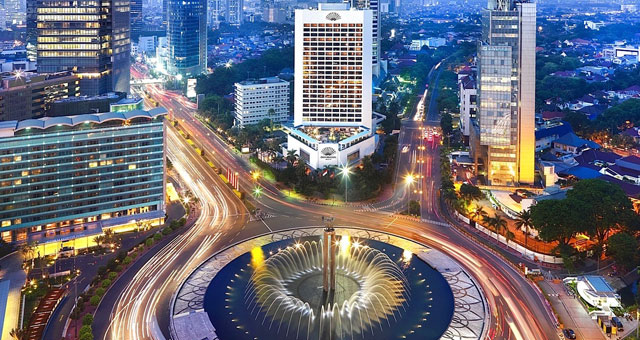
1.Central Jakarta (Jakarta Pusat: Pop. 898.883) is the most densely populated district and home to most of the city’s skyscrapers. The district is the central government office, Bank Indonesia, the big mosque of Istiqlal, the big shopping center of Grand Indonesia and numerous museums.
2.East Jakarta (Jakarta Timur: Pop. 2,687,027)
3.North Jakarta (Jakarta Utara: Pop. 1,645,312)
4.South Jakarta (Jakarta Selatan: Pop. 2,057,080)
5.West Jakarta (Jakarta Barat: Pop. 2,278,825)
The only regency of Jakarta is Thousand Islands (Kepulauan Seribu: Pop. 21,071), formerly a subdistrict of North Jakarta.
Fast Facts
Country : Indonesia
Continent : Asia
Population : 10,187,595
Area : 740.28 km2
Elevation : 7 m
Temperature in Jakarta : January – 29°/23°C (84°/73° F)
July – 31°/23°C (88°/73° F)
Average daily High/Low °C (°F)
Time Zone in Jakarta:+7 hours UTC (Coordinated Universal Time)
▪ Jakarta is located on the Indonesian island of Java.
▪ It is the capital and the largest city of Indonesia.
▪ Jakarta is the eleventh largest city in the world.
▪ Jakarta officially is not a city. It is a province which has been given the special status of being the capital.
▪ The number of people residing in greater Jakarta is estimated at 23 million, making it the fourth largest urban area in the world.
▪ There are about 13 rivers flowing through Jakarta. The most important river is the Ciliwung River, which divides the city into two parts: the western and eastern hemispheres.
▪ Jakarta was once part of the Dutch East India Company and gained its independence in 1945.
▪ Jakarta is sometimes called “The Big Durian” by foreigners resident in the city.
▪ Jakarta provides the gateway to many islands, which offer different cultures, jungles, beaches and adventure.
▪ Jakarta has often played host for international sport events, such as Asian Games of 1962 and Asian Cup of 2007.
▪ Jakarta provides an interesting fusion of modern western architecture and traditional Indonesian culture.
▪ Jakarta can be divided into three sections- the old town in the north, with Javanese, Chinese, and Arab quarters; central Jakarta, with high-rise buildings; and a modern residential garden suburb in the south.
▪ Here, you will find that ‘Betawi Malay’ is the official language for the elderly in Jakarta and the more modern, ‘Jakarta Malay’ is a commonly spoken by the younger generation in the city.
▪ This great city finds its origins in the harbor town of Sunda Kelapa, in the early 16th century.
▪ After the city was founded, it was initially re-named to ‘Jayakarta’, meaning ‘Splendid Victory’ by Prince Fatahillah.
▪ 150 centimeters of the city’s depth has sunk in many places over the last decade, due to natural calamities.
▪ Before Jakarta earned the name it has today, it was initially named Sunda Kelapa, Jayakarta, Batavia and Djakarta.
▪ Jakarta is one of the few cities in South East Asia, with the largest number of museums in the city.
▪ The average rainfall in the city is around 2,000 mm per year and the temperature constantly varies between 22°C and 33°C .
▪ The national stock exchange of Indonesia, the Bank of Indonesia, and the National Monument (Tugu Monas) are some of the major landmarks in Jakarta city.
▪ The city of Jakarta offers you a perfect mixture of western architecture and traditional Indonesian culture.
▪ Jakarta is a well connected destination served by the Soekarno-Hatta International Airport and Halim Perdanakusuma International Airport.
▪ Jakarta is the largest city in terms of population in South East Asia. Its population is estimated at 8,489,910.
▪ Jakarta is an ideal place to start your tour for various islands of Indonesia as it is very well connected with major places in Southeast Asia.